'... and without necessarily calling them Economic Surveys.' 'One should stick to the main focus, which is to give people a good perspective on how the economy is doing.'

'They have started becoming an important player, but not at the same level as they were in the earlier part of the decade.'
'...Market-linked debentures, high-value insurance, exemptions from capital gains by investment in real estate, etc.' 'So, there are a number of measures directed at collecting a fair share from higher income individuals.'

'I believe the modified scheme is much more beneficial and simpler.'

Ahead of the 2023-24 Union Budget, the thinking at the top level of the central government is clear: Gross domestic product (GDP) growth of 6-6.5 per cent is a comfortable enough target for FY24 and the focus should be on fiscal consolidation to ensure that the sovereign cost of borrowing does not become prohibitively expensive in a high-interest rate environment, according to people in the know. Those aware of deliberations between the Prime Minister's Office (PMO) and the Ministry of Finance said while the Budget would look to strike a balance between infrastructure investment and welfare schemes, it is unlikely to be populist, though it will be the last full-year Budget before the 2024 Lok Sabha election. Incidentally, 6-6.5 per cent GDP growth is what the upcoming 2022-23 Economic Survey is expected to project for FY24.

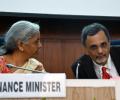
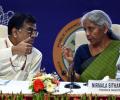
Coming Wednesday, Finance Minister (FM) Nirmala Sitharaman will present the 2023 Union Budget - the last full Budget ahead of the 2024 Lok Sabha elections. While India exited 2022 as a relatively bright spot in the global economy, the FM will endeavour to present a Budget that insulates India's economy against global headwinds and recession in advanced economies, while sticking to the path of fiscal consolidation. In this, she is being helped by her core team of trusted advisors.

Ahead of the Budget, the government has achieved almost half the divestment target of Rs 65,000 crore. FY23 divestment receipts are unlikely to be anywhere close to the budgeted target.

'Each state and central government body may be asked to update its system to ensure PAN is used as a common identification to access its services.'

For fiscal year FY23, the 2022 Union Budget had targeted a capex outlay of Rs 7.5 trillion, which is 35.4 per cent higher than the FY22 Budget Estimate of Rs 5.54 trillion.

Government's focus on infrastructure is the biggest positive for the Indian economy, followed by the improvement in tax collections and good consumption recovery.

'It has been an ongoing process, talking to the relevant ministries about eliminating leakages and curbing non-core expenditure in various schemes.'

As a percentage contributor to nominal GDP, PFCE's share was 60.1 per cent in FY23, compared with 59.6 per cent and 60.8 per cent in the two preceding fiscal years. "Although PFCE is expected to grow 7.7 per cent in FY23, we believe it is still short of a broad-based recovery. "The current consumption demand is highly skewed in favour of goods and services consumed largely by the households falling in the upper income bracket. "A broad-based consumption recovery, therefore, is still some distance away," said Sunil Kumar Sinha, principal economist with India Ratings.

Senior tax officials were told to focus on cash collection from the arrears so that the target for FY23 was achieved and the overall revenue position improved.
In November, the fiscal deficit widened by Rs 2.2 trillion, the highest ever in any month this financial year.

'There are unscrupulous traders who create fake invoices by showing bogus e-way bills, movement of goods.' 'Since the entities registered across different states, and kept on changing their numbers, tracing them was difficult.'

India has been relatively insulated from the severe headwinds in the West. However, with a third of the global economy expected to slip into recession in calendar year 2023, the impact will strongly be felt on India's exports and trade economy, leading economists said in a panel discussion at the Business Standard BFSI Insight Summit in Mumbai on Wednesday. The panel comprised former Reserve Bank of India executive director and former Monetary Policy Committee member Mridul Saggar, State Bank of India Chief Economic Advisor Soumya Kanti Ghosh, Citibank India Chief Economist Samiran Chakraborty, ICRA Chief Economist Aditi Nayar, and IndusInd Bank Chief Economist Gaurav Kapoor. The topic of the panel discussion was No recession in sight: Is India decoupled from developed economies?

Ahead of the Union Budget for 2023-24, Budget makers have welcomed the global consensus view that India will remain one of the bright spots in calendar year 2023. But there is some alarm over the grim global situation and how that might impact the Centre's projections and assessments for next financial year. The big global headwinds include a deep and sustained recession in the West, including India's biggest trading partners in North America and Europe, continuing volatility in commodity markets, and renewed Covid-19 fears, as lifting of strict curbs by China could potentially lead to a massive spread again.

Policymakers are examining the possibility of increasing the tax-free slab to Rs 5 lakh in the two-year-old alternative personal income tax regime to make it attractive, a government official said. At present, taxpayers don't pay income tax if their taxable income is Rs 2.5 lakh and below. Increasing the threshold will reduce the tax outgo for assessees, thereby leaving more money with them to invest, the official said.

The Union government could target a fiscal deficit of 5.8-6 per cent of nominal GDP for 2023-24, and it should continue its capital expenditure push and look to simplify the personal income tax regime, economists recommended Finance Minister Nirmala Sitharaman and her team during their pre-Budget interaction on Monday. Starting last week, Sitharaman had eight pre-Budget consultations this time. More than 110 invitees representing seven stakeholder groups participated in these meetings, the finance ministry said in a statement. The stakeholder groups included representatives and experts from agriculture and agro-processing industry; industry, infrastructure & climate change; financial sector and capital markets; services and trade; social sector; trade unions and labour organisations; and economists.

Crypto exchanges have been asked to furnish details this month itself.
 © 2025 Rediff.com - Investor Information - Advertise with us - Disclaimer - Privacy Policy - Sitemap - Feedback - About us - Terms of use - Grievances